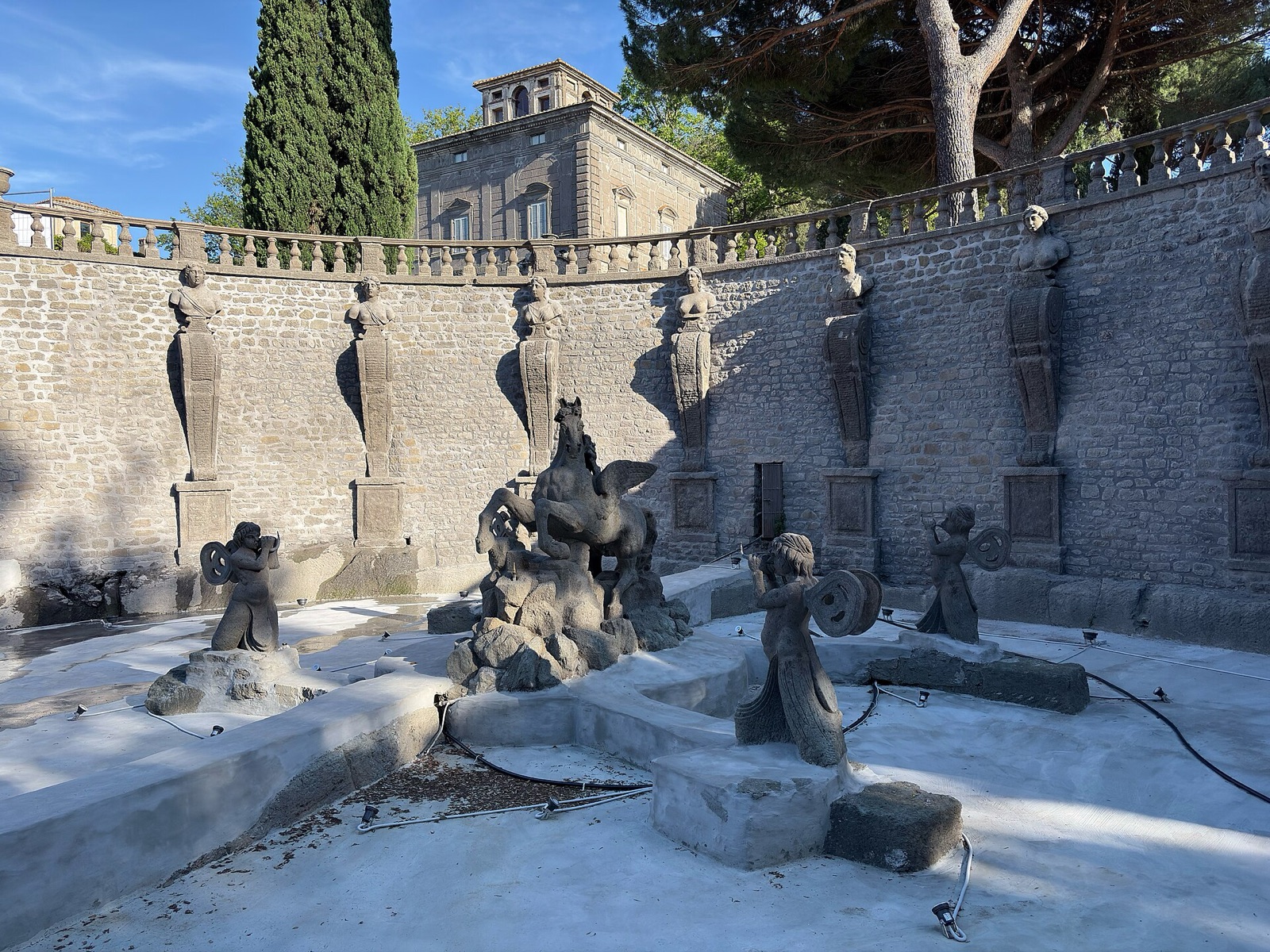
Villa Lante in Bagnaia is considered one of the most perfect examples of Italian Mannerist garden design. Created in the 16th century, this masterpiece of landscape architecture is renowned for its harmonious blend of architecture, sculpture, and nature, all unified by the theme of water.
The garden was commissioned by Cardinal Gianfrancesco Gambara, who began construction around 1566 on designs attributed to the great architect Jacopo Barozzi da Vignola. Later, Cardinal Alessandro Peretti di Montalto completed the project. Unlike most Italian Renaissance villas, Villa Lante emphasizes the garden over the buildings, which consist of two small, nearly identical casini (pavilions) rather than a grand palace.
The garden is laid out on a central axis that descends a hillside through a series of terraces. Water is the unifying element, flowing from the upper fountain of the Deluge through a chain of basins, fountains, and water features, including the famous Fountain of the Moors and the impressive Water Chain (Catena d'acqua), a water staircase flanked by stone balustrades.
Each terrace represents a different stage in the relationship between nature and civilization, from the wild upper areas to the geometrically perfect parterres at the lowest level. The garden is adorned with numerous sculptures, grottos, and architectural elements that create surprising visual effects and symbolic meanings.
Villa Lante exemplifies the Renaissance ideal of harmony between man and nature, showcasing the period's fascination with classical mythology, geometry, and hydraulic engineering. Today, it stands as one of Italy's most important historical gardens and a testament to the artistic achievements of the late Renaissance.
Villa Lante a Bagnaia è considerata uno degli esempi più perfetti del giardino manierista italiano. Realizzato nel XVI secolo, questo capolavoro di architettura del paesaggio è celebre per l'armonioso connubio di architettura, scultura e natura, unificato dal tema dell'acqua.
Il giardino fu commissionato dal cardinale Gianfrancesco Gambara, che ne iniziò la costruzione intorno al 1566 su disegni attribuiti al grande architetto Jacopo Barozzi da Vignola; lo completò poi il cardinale Alessandro Peretti di Montalto. A differenza di molte ville rinascimentali, Villa Lante privilegia il giardino sugli edifici, costituiti da due piccoli casini quasi identici anziché da un grande palazzo.
Il giardino si sviluppa su un asse centrale che scende lungo il pendio in una serie di terrazze. L'acqua è l'elemento unificante: scorre dalla Fontana del Diluvio attraverso una catena di vasche e fontane, tra cui la celebre Fontana dei Mori e l'imponente Catena d'acqua, una scala d'acqua fiancheggiata da balaustre in pietra.
Ogni terrazza rappresenta una diversa fase del rapporto tra natura e civiltà, dalle aree selvagge in alto ai parterre geometricamente perfetti in basso. Il giardino è ornato da numerose sculture, grotte ed elementi architettonici che creano effetti visivi sorprendenti e significati simbolici.
Villa Lante incarna l'ideale rinascimentale di armonia tra uomo e natura, testimoniando la fascinazione dell'epoca per la mitologia classica, la geometria e l'ingegneria idraulica. Oggi è uno dei più importanti giardini storici d'Italia.
Die Villa Lante in Bagnaia gilt als eines der vollkommensten Beispiele des italienischen manieristischen Gartens. Das im 16. Jahrhundert geschaffene Meisterwerk der Landschaftsarchitektur ist berühmt für das harmonische Zusammenspiel von Architektur, Skulptur und Natur, vereint durch das Thema Wasser.
Den Garten gab Kardinal Gianfrancesco Gambara in Auftrag, der den Bau um 1566 nach Entwürfen begann, die dem großen Architekten Jacopo Barozzi da Vignola zugeschrieben werden; vollendet wurde er von Kardinal Alessandro Peretti di Montalto. Anders als die meisten Renaissancevillen stellt die Villa Lante den Garten über die Gebäude, die aus zwei kleinen, fast identischen Casini statt einem großen Palast bestehen.
Der Garten erstreckt sich entlang einer Mittelachse, die in mehreren Terrassen den Hang hinabführt. Wasser ist das verbindende Element: Es fließt von der Sintflut-Fontäne durch eine Kette von Becken und Brunnen, darunter die berühmte Mohren-Fontäne und die eindrucksvolle Wasserkette (Catena d'acqua), eine von Steinbalustraden gesäumte Wassertreppe.
Jede Terrasse steht für eine andere Stufe im Verhältnis von Natur und Zivilisation – von den wilden oberen Bereichen bis zu den geometrisch perfekten Parterres ganz unten. Zahlreiche Skulpturen, Grotten und Architekturelemente schaffen überraschende Effekte und symbolische Bedeutungen.
Die Villa Lante verkörpert das Renaissance-Ideal der Harmonie zwischen Mensch und Natur und zeugt von der Faszination der Zeit für klassische Mythologie, Geometrie und Wasserbaukunst. Heute zählt sie zu den bedeutendsten historischen Gärten Italiens.
HighlightsPunti salientiHighlights
- Twin Casini - Two nearly identical pavilions framing the garden
- Fountain of the Deluge - Upper fountain representing the wild forces of nature
- Water Chain (Catena d'acqua) - Elegant water staircase with carved stone balustrades
- Fountain of the Moors - Central fountain with four Moor figures
- Geometric Parterres - Perfectly symmetrical formal gardens on the lowest terrace
- Casini gemelli – due padiglioni quasi identici incorniciano il giardino
- Fontana del Diluvio – fontana superiore che rappresenta le forze selvagge della natura
- Catena d'acqua – elegante scala d'acqua con balaustre scolpite
- Fontana dei Mori – fontana centrale con quattro figure di Mori
- Parterre geometrici – giardini formali perfettamente simmetrici sulla terrazza più bassa
- Zwillings-Casini – zwei fast identische Pavillons rahmen den Garten
- Sintflut-Fontäne – obere Fontäne als Sinnbild der wilden Naturkräfte
- Wasserkette (Catena d'acqua) – elegante Wassertreppe mit gemeißelten Balustraden
- Mohren-Fontäne – zentrale Fontäne mit vier Mohrenfiguren
- Geometrische Parterres – perfekt symmetrische formale Gärten auf der untersten Terrasse
Join the Lazio Expats communityUnisciti alla community Lazio ExpatsTritt der Lazio-Expats-Community bei
Connect with fellow travelers and expats in Lazio. Share tips, hidden gems, local events and meetups — all in our friendly WhatsApp group.
Entra in contatto con viaggiatori ed espatriati nel Lazio. Condividi consigli, luoghi segreti, eventi locali e incontri — tutto nel nostro gruppo WhatsApp.
Vernetze dich mit Reisenden und Expats im Latium. Teile Tipps, Geheimtipps, lokale Events und Treffen — alles in unserer freundlichen WhatsApp-Gruppe.
Join on WhatsAppUnisciti su WhatsAppBei WhatsApp beitreten
Lazio Expats
Scan to join the group
Scansiona per unirti al gruppo
Scannen, um beizutreten